
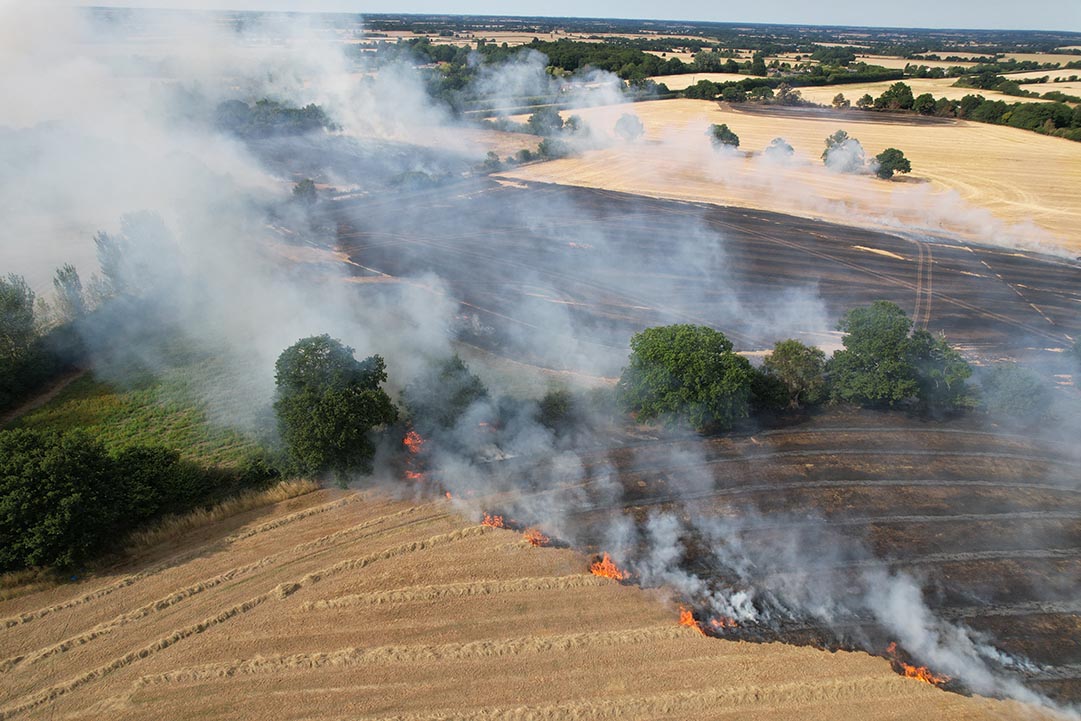
Halliwell’s Fire Research UK team calls for a national approach to wildfire prediction, fire service preparedness and building resilience as incidents increase
Wildland-urban interface areas are particularly vulnerable, including London, which - with over 20% green cover - is technically classified as a forest city
LONDON, JULY 2026: Halliwell’s Fire Research UK team, part of the multidisciplinary forensic and technical consultancy, Halliwell, is warning that the UK needs to improve its preparedness for wildfire and wildland urban interface (WUI) fire risk, as incidents become more frequent and the underlying conditions that drive them become more severe. The warning comes as fires break out across the UK in dry conditions this summer.
Dr Nadia Mofidi, Principal and Head of Halliwell Fire Research UK & EU, notes that “while individual ignition sources vary - industrial incidents, garden equipment, discarded materials - the underlying vulnerability is consistent: dry soil, desiccated vegetation, and urban areas that border open land without adequate protective measures in place.”
Dr. Mofidi is leading a multi-layered wildfire risk mapping project in collaboration with the University of Liverpool, combining soil moisture analysis, vegetation data, and wildland-urban interface mapping to build the first systematic framework for understanding where wildfire risk is highest across the UK.
Early findings from the soil moisture strand of the research - conducted by Judy Sedgewick - indicate a 58% alignment between drought conditions identified by the model and recorded summer wildfire events, with risk most concentrated in southern and southwestern England. Dr. Mofidi notes that soil moisture loss is a slow process, often building over years before a single heatwave creates the conditions for a significant fire event.
A central concern highlighted by the research is the lack of a national wildfire prediction system or a coordinated approach to fire service training for wildland-urban interface events - fires that spread between open land and built-up areas. According to Dr. Mofidi: “The National Fire Chiefs Council has taken steps to address this, introducing wildfire guidance and awareness training for fire and rescue services. However, as the frequency and complexity of incidents increase - particularly at the wildland-urban interface in densely populated areas - the pace and scale of that preparedness effort will need to increase. Fire services in Wales and Scotland have had more experience through greater historical exposure to moorland and hillside fires; however, in England, experience and expertise is currently more focused on single-building fires.”
The UK also lacks the building regulation framework requirements that exist in countries with more established wildfire risk, including Australia, Canada, and the United States. In those countries, householders in at-risk areas are required to maintain defensible space around their properties, and construction standards address the fire resistance of external elements, including roofs, windows and fencing materials, that can otherwise allow fire to spread rapidly from property to property.
Dr. Mofidi added “The incidents we are seeing this summer are not outliers; they are consistent with a trend that our research is beginning to quantify. We have no dedicated wildfire prediction system, no national training framework equipping all first responders to deal with these events, and no building codes addressing how properties in at-risk areas should be constructed or maintained. Countries that have faced large-scale wildfire events have learned those lessons the hard way. The UK has an opportunity to get ahead of this before the scale of loss demands it, including supporting additional research and data analysis.”
“For the insurance industry in particular, this is a risk that is currently very difficult to price or model in the UK, because the underlying data simply does not yet exist at scale. That gap matters, both for insurers and for the policyholders who assume they are adequately covered for events that no-one has properly assessed.”
ENDS
NOTES TO EDITORS
About Halliwell:
Halliwell is a multidisciplinary forensic and technical consultancy providing engineering, forensic investigation, fire science, and construction consulting services to insurers, reinsurers, law firms, corporations, and government agencies worldwide. Specialist services include Forensic & Fire Science - encompassing fire and explosion investigation, applied fire research, fire protection engineering, and Wildland Urban Interface (WUI) mitigation - alongside construction services, passive fire advisory, forensic engineering, building code compliance, quantity surveying, and GIS/forensic meteorology.
For media enquiries or to arrange an interview with Dr. Mofidi, please contact:
Ed Smith, Highbury Communications | esmith@highburycomms.com | 07983 245873